
Cleveland Heights Resident Lookup Records
A useful Cleveland Heights resident lookup chooses a source by the fact it can confirm. No portal proves that every person connected to a name currently lives at one address. The Cuyahoga County property system distinguishes parcel details from an owner or mailing field. Voter, court, vital, and historical records each have their own dates, public limits, and custodian. Treat the result as an evidence lead, then compare it against another record that has a different role.
| Record | What it confirms | Where | Access |
|---|---|---|---|
| MyPlace property record | Parcel owner, situs, tax, transfer, and map context, not every resident | Cuyahoga County MyPlace | Public county interface; custodian record controls |
| Recorded document index | Grantor, grantee, document, parcel, address, or legal-description role | Recorded Document Search | County states 1810-present; downloads are free |
| Voter registration | Permitted registration, precinct, and history fields at the record date | Ohio My Voter Information | Statutory exclusions and confidential records apply |
| Court docket | Party role, case event, and disposition, not a definitive residence | Cleveland Heights Municipal Court, Clerk, Probate, or PACER | Jurisdiction and remote-access rules differ |
| Vital or probate record | Event or estate lead for family history, not a current location | ODH, Cuyahoga Probate Court, or County Archives | Application, copy, and confidentiality rules vary |
If the question is about an old household rather than one current record, a dated volume is the better first source. The separate Cleveland Heights historical collections are explained in the Cleveland Heights city directory material.
Cleveland Heights Property Records Verification
For a property question, begin with MyPlace and select Cleveland Heights in the municipality filter. The live county interface supports Owner, Parcel, and Address modes. Open the candidate record and preserve the owner field, situs address, parcel number, transfer information, and date. A situs is the physical parcel address. A mailing address is correspondence information and can differ from the situs, so neither field should be relabeled as proof of present household membership.
Next, take the owner name and acquisition details to Recorded Document Search. Its advanced route can search party name, date, document type, parcel, address, and legal description. The Recorder describes its documents as covering 1810 to the present. A grantor is the person conveying an interest; a grantee is the person receiving one. Those roles confirm a document event, not continued occupancy after the event.
- Search MyPlace by the strongest known mode: owner, parcel, or street address.
- Save the parcel number, situs, transfer date, and legal description from the candidate record.
- Search Recorded Document Search with the party name and document date, then compare the parcel or legal description.
- When fields conflict, ask the Fiscal Office or Recorder for the controlling record instead of merging the results.
Note: Matching a parcel and legal description is stronger than matching a common name with only the city label.
Cleveland Heights Voter Lookup Search
Ohio's public voter form is a one-person verification tool. It requires First Name, Last Name, and County, with Cuyahoga selected for Cleveland Heights. The form does not begin with an address-only or streetwide browse mode. Its own search tips direct a user to try a derivative first name, a former surname, or a previous address in another Ohio county. An unsuccessful result can reflect a name change, a different county, a cancellation, a correction, or a protected record.
| First Name | Required text field; the official tips allow a derivative or variant first name. |
|---|---|
| Last Name | Required text field; try a former surname where appropriate. |
| County | Required dropdown; choose Cuyahoga for Cleveland Heights. |
| Street name | Conditional narrowing field after a result is selected. |
| Search | Runs the official voter lookup. |
Ohio Revised Code sections 3503.13 and 3503.153 distinguish permitted public fields from excluded identifiers and protected records. Ballot choices are not displayed. For a registration correction or a question about an unsuccessful search, the Cuyahoga County Board of Elections is the appropriate custodian.
Cleveland Heights Court Lookup Routes
Court research needs the right jurisdiction. Cleveland Heights Municipal Court CaseLook offers Record Search, Hearing Calendar, and Probation Search. The local rules state that current dockets and available electronic files can be obtained through the court website, and electronic retention applies to cases filed after January 1, 2011. Search a full legal name with a known date or case number when possible, record the case number, and then use the Clerk's procedure for supervised paper review or copies.
For Common Pleas General Division, Domestic Relations, and Eighth District Court of Appeals material, use the Cuyahoga County Clerk of Courts and its case-record system. Probate matters, including estates, guardianships, adoptions, and marriage licenses, belong with Cuyahoga County Probate Court. Federal matters belong in PACER for the Northern District of Ohio. A court caption may contain a service, business, attorney, historical, or redacted address, so it must not be treated as residence evidence.
The official Common Pleas docket search includes Civil Case, Civil Name, Foreclosure, criminal, and Court of Appeals routes. The captured portal image reflects that search surface. Civil Case reporting begins in 1950 and Civil Name reporting in 1980; certain protection-order information is unavailable online.
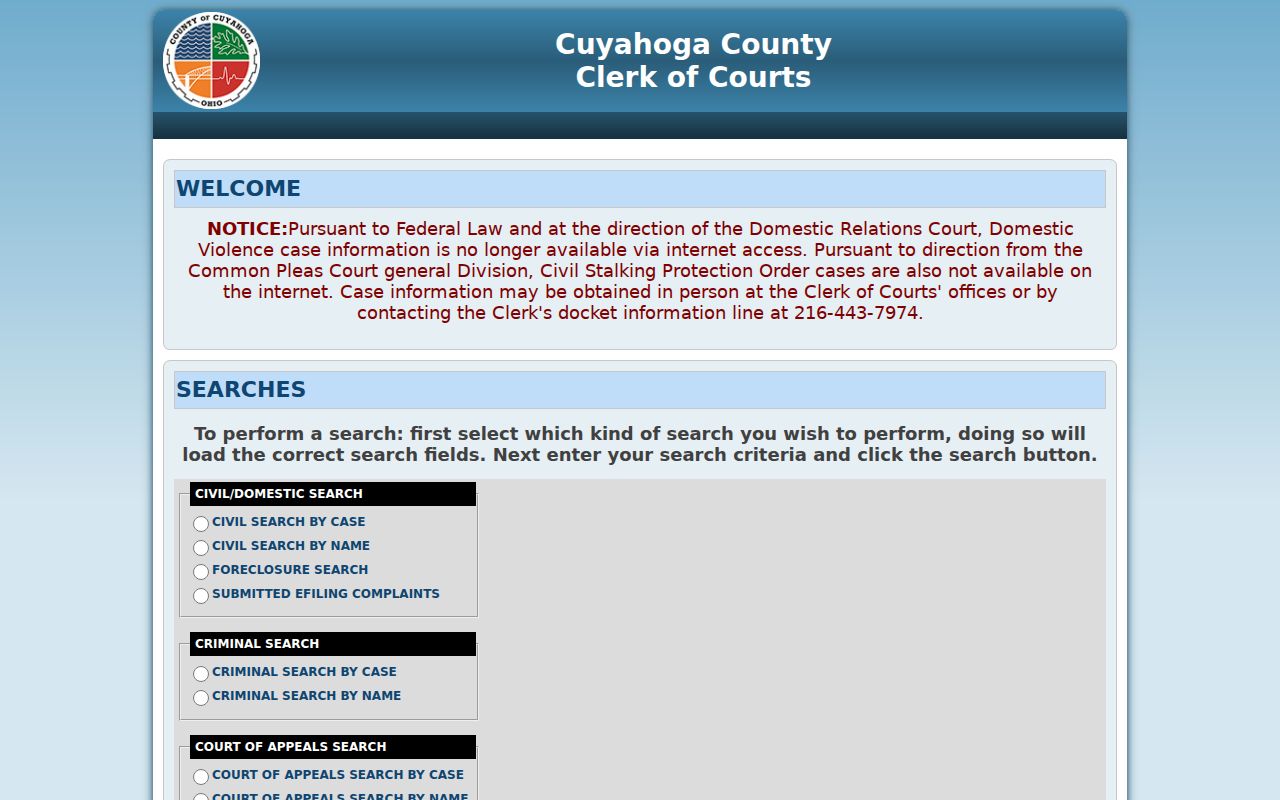
The docket is a case lead. The Clerk or court holds the official file, and division-specific rules can limit remote document access even when a general docket is visible.
Cleveland Heights Resident Lookup Results
A court result should be copied as a small record inventory rather than reduced to a person's name. Case number, party role, filing date, and disposition help distinguish people with the same name and let the custodian find the correct file. Available electronic images are not guaranteed, and restricted, sealed, expunged, juvenile, adoption, and protected categories are not general name-search material.
| Court and division | Identifies the custodian and the kind of jurisdiction involved. |
|---|---|
| Case number | The precise reference to capture before contacting a clerk. |
| Caption and party role | Shows the printed names and legal role, not a personal profile. |
| Filed date and case type | Anchors the result in time and explains the docket category. |
| Docket event and disposition | Shows recorded activity and, where displayed, the case outcome. |
| Document availability | Records whether an image or a custodian request is needed. |
- Docket
- A chronological list of events in a court case. It is not automatically the full file.
- Index versus image
- An index points to a record. An image is the document itself, which may have separate access limits.
- Certified copy
- A copy issued by the custodian with the certification required for official use. The issuing office controls the procedure.
Verify a Cleveland Heights Resident
Use a Cleveland Heights resident lookup as a sequence of independent checks. Start from the strongest fact already known, such as a full spelling, former name, approximate time, parcel, document number, or case number. Each next search should test one detail from the prior source. A matching name by itself is weak evidence, especially where city directories use initials and the deed index accepts party names in LASTNAME FIRSTNAME form.
- Anchor the candidate to a property, voter, historical directory, or court record that matches the question being asked.
- Record the date, source, full printed name, and any parcel, case, precinct, or volume reference.
- Search a second official index using a name variant, then compare an independent detail such as legal description, event date, occupation, or court division.
- For a needed official copy, contact the custodian with the saved record reference rather than relying on a search-screen summary.
- When two records disagree, preserve both and ask the responsible office about the specific record.
A name can change through marriage, divorce, adoption, initials, abbreviations, or ordinary spelling variation. Compare several independent anchors. Four compatible official records are more meaningful than repeated copies of one stale source.
Cleveland Heights Vital Records Trail
Marriage, death, and probate materials often answer a family-history or heir question better than a general resident lookup. Ohio Revised Code 3705.23 directs the state director or local registrar to issue a certified vital-record copy after a signed application and fee unless a statutory confidentiality provision applies. It is not a generic 50- or 100-year closure rule. The medical-and-health-use portion of a birth record has separate limits.
Cleveland Heights directs local birth and death certificate seekers to the City of Cleveland Office of Vital Records; the City says its death copies cover Cuyahoga County except Lakewood and Parma. For older events, Cuyahoga Archives lists births from 1849 to 1908, not inclusive, deaths from 1840 to 1908, and marriage records from 1810 to 1941. Cuyahoga Probate handles marriage certificates and estate matters. A vital index provides a lead, while a certified copy comes from the office that controls it.
The Probate Docket and Index asks users to agree to terms and supports decedent-name and date research. The official portal image shows the Probate route assigned to this Cleveland Heights resident lookup.
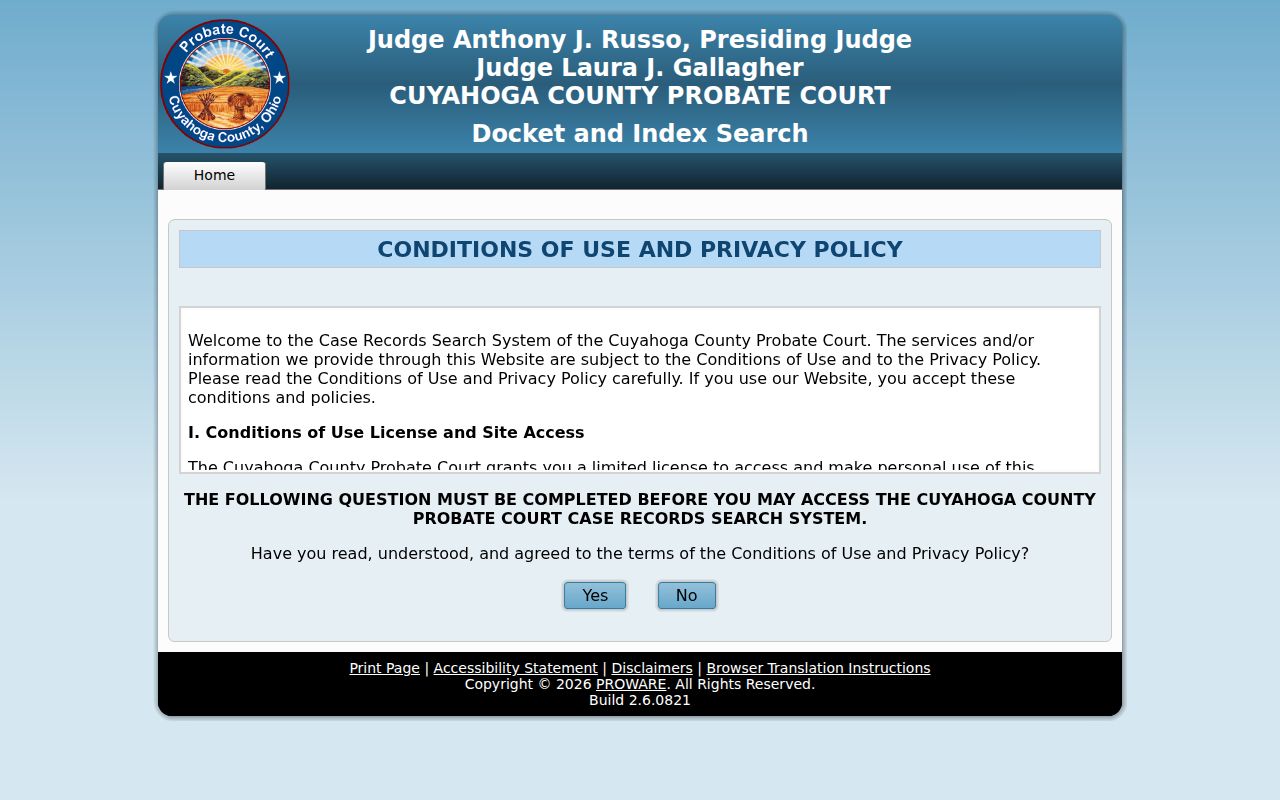
For a current case, save the case number and use the court's copy process. County Archives estate indexes cover 1813 to 1993, while older estate case files are a separate historical research path.
Note: Describe a marriage certificate, marriage application, divorce docket, or estate file precisely so the custodian can locate the correct record.
Cleveland Heights Resident Name Checks
Same-name errors are common in a Cleveland Heights resident lookup. Use the voter portal's variant and former-name tips, the deed index's LASTNAME FIRSTNAME style, and the initials printed in historical directories as search techniques, not as excuses to combine results. A property transfer identifies a person in a conveyance role. A court caption identifies a party in a case. A directory identifies someone listed in a printed edition. Compare the date and the role before deciding whether the records concern the same person.
For an estate trail, start with the decedent's exact name and date in Probate or the Archives estate index, then compare the estate case with any recorded transfer document. For a former classmate, yearbooks, directories, and newspaper archives are dated historical sources. Ohio's official business search can identify a statutory-agent or entity-filing role, but the Secretary of State does not maintain an owner or officer list, so that result is not a personal-residence determination.
Cleveland Heights Resident Lookup Limits
Some Cleveland Heights resident lookup results should be absent. Ohio Safe at Home participants may have confidential voter registration and a real-property confidentiality notice. Under ORC 111.43 and ORC 111.44, a designated address and confidential registration can keep a participant's name, address, and precinct out of public-facing voter records. Ohio public-records exemptions also protect specified information.
A suspected error belongs with its custodian: the Fiscal Office for a property record, the court or Clerk for a docket matter, the Board of Elections for registration, and the issuing vital office for a certificate correction. The Ohio Public Records Act permits prompt inspection and copies subject to listed exemptions; it cannot force disclosure of protected information.
Lawful use. Use Cleveland Heights records for personal, lawful research and do not try to reconstruct protected information. Ohio law prohibits stalking and telecommunications harassment; never use a record to monitor, contact, threaten, or harm someone.
Cleveland Heights Court Record Checks
Public details can be misused in a scam. On June 10, 2026, the Ohio Attorney General warned about court-related messages that claim missed jury duty, an arrest, or a bond demand while borrowing real judge or case details. A request for payment by gift card, cash deposit, or money transfer is a warning sign. Legitimate jury notices are mailed, according to the Attorney General's warning.
Verify any notice through the court's official contact route, not a number or link supplied in the message. The Ohio Attorney General's court-notice warning gives the current statewide reporting channel. A resident lookup can identify a public docket reference, but it should never be used to respond to or investigate a person who sends a threatening message.