
Cleveland Heights City Directory Holdings
Cleveland Heights did not remain in one directory series. The Cleveland Public Library, or CPL, reports a complete microfilm run of Cleveland City Directories and an extensive but incomplete paper-facsimile set. Its 1925 title page specifically names Cleveland Heights among the suburbs covered. Coverage before that year must be checked in the individual volume. By 1949, the local trail moved to a separate Cleveland Heights series rather than the general Cleveland volumes. A city directory is an alphabetical list that can include residents, businesses, public buildings, schools, and societies, so its value goes beyond a telephone listing.
| Collection | Years | Where held | Access |
|---|---|---|---|
| Cleveland City Directories | Complete CPL microfilm set; Cleveland Heights documented in 1925 | CPL Center for Local and Global History | Microfilm and selected digital material |
| Five-city Cleveland Heights series | 1949; 1951; 1953-56; 1958-63 | CPL directory holdings | Confirm the title page and selected volume |
| East Suburban City Directory | 1964, 1965, 1967, 1968, 1969/70, 1971, 1972, 1976, 1978/79 | CPL directory holdings | Shelf or scan verification |
| County Archives directories | 1837-1972, not inclusive | Cuyahoga County Archives | Appointment, microfilm, email, or mail research request |
Use the CPL genealogy guide to identify the collection, then record the actual year on the volume used. A missing issue is not evidence that a household moved. The documented Cleveland-proper gaps include 1933, 1945-46, 1948-50, 1952, 1962, 1967, 1971, 1973, 1975, and 1976, along with earlier nineteenth-century gaps.
Cleveland Heights Directory Volume Timeline
The transition matters most for a name that seems to vanish after the 1940s. CPL identifies Cleveland City Directory Co. as the publisher of the five-city Cleveland Heights, East Cleveland, Shaker Heights, University Heights and South Euclid City Directory. Its documented issues begin with volume 1 in 1949 and include 1951, 1953-56, and 1958-63; Lyndhurst joined the title coverage in 1958. The subsequent East Suburban volumes at CPL have their own uneven run. A Cleveland-proper book from the 1950s should not be treated as a complete Cleveland Heights source.
| Before 1925 | Some adjacent-suburb coverage is possible, but individual volumes control. |
|---|---|
| 1925 | The CPL guide documents Cleveland Heights on the Cleveland directory title page. |
| 1949-1963 | Use the separate five-city title, not a general Cleveland volume. |
| 1964-1978/79 | Check the documented East Suburban holdings and their gaps. |
| After the 1990s | The Historical Society reports that directories of this type were no longer printed. |
That changing scope is a local records story. It can create a false household break if a search jumps from a 1925 Cleveland volume to a later general-city book. Carry the volume title, year, page, and column with each finding so another researcher can test the same evidence.
Note: Directory coverage follows publisher and geography decisions, so compare nearby years before treating one blank result as a move.
Cleveland Heights Directory Shelves Online
Several Cleveland Heights directory access channels complement one another. CPL downtown keeps historical directories and telephone books in History/Geography. The County Archives maintains its directory collection from 1837 through 1972, not inclusive, and its research form includes a City Directory topic. Its route includes reference assistance, self-service microfilm, email, and mail requests, although property research requires an appointment. Heights Libraries adds Cleveland and East Suburban directories, Heights High yearbooks and alumni directories, local archival material, and newspaper microfilm through its Lee Road Local History Room.
Start with the CPL Digital Gallery collection for its digitized City Directories and Blue Books. The captured image uses that collection route. A selected directory may also be available through a library database, but card or location access can apply, so check the current library terms before relying on an at-home result.
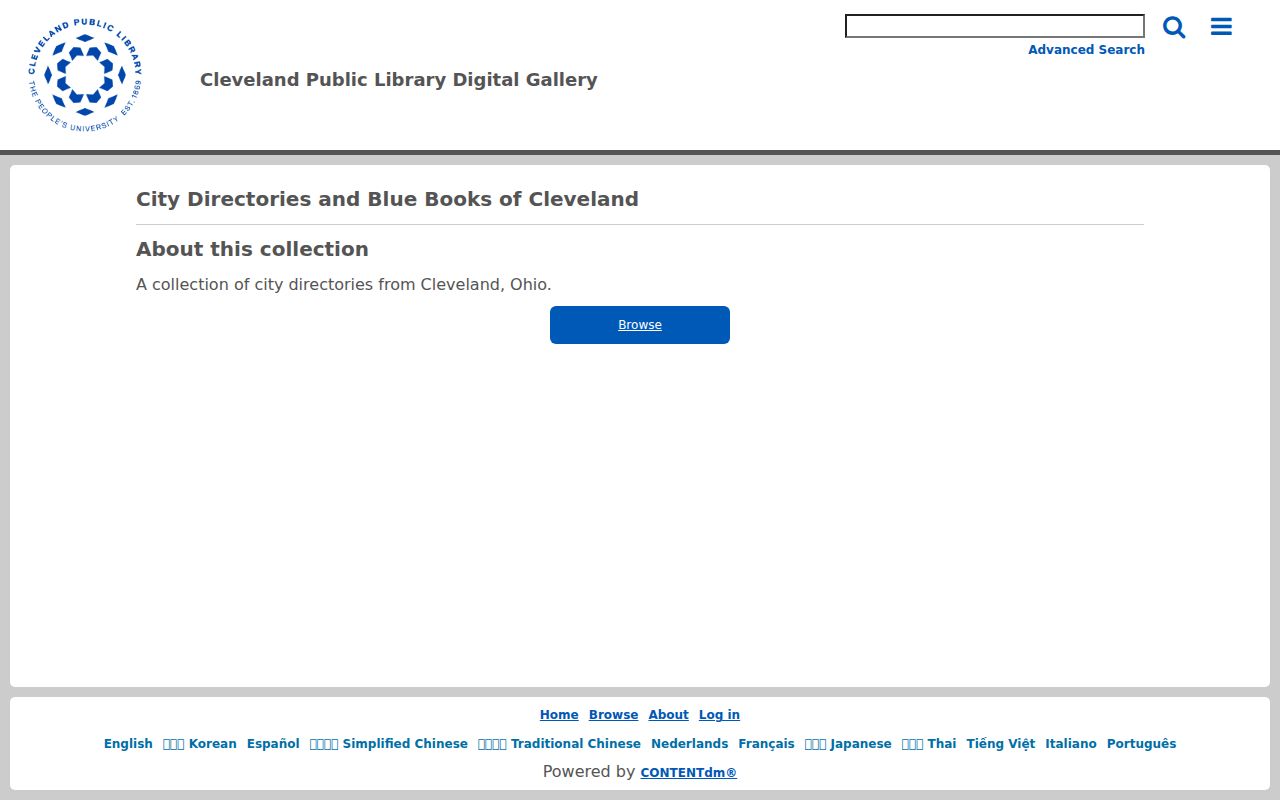
The digital collection is a starting shelf, not proof that every printed volume has been scanned. When a scan is absent, CPL microfilm and the archives request channel remain documented alternatives.
The Heights Libraries Local History Room is a useful local stop for yearbooks, alumni materials, and newspaper context. Appointments through the library's local-history contact are recommended. Its nearby collections help establish the date, school, institution, or neighborhood around a directory entry without presenting a current resident roster.
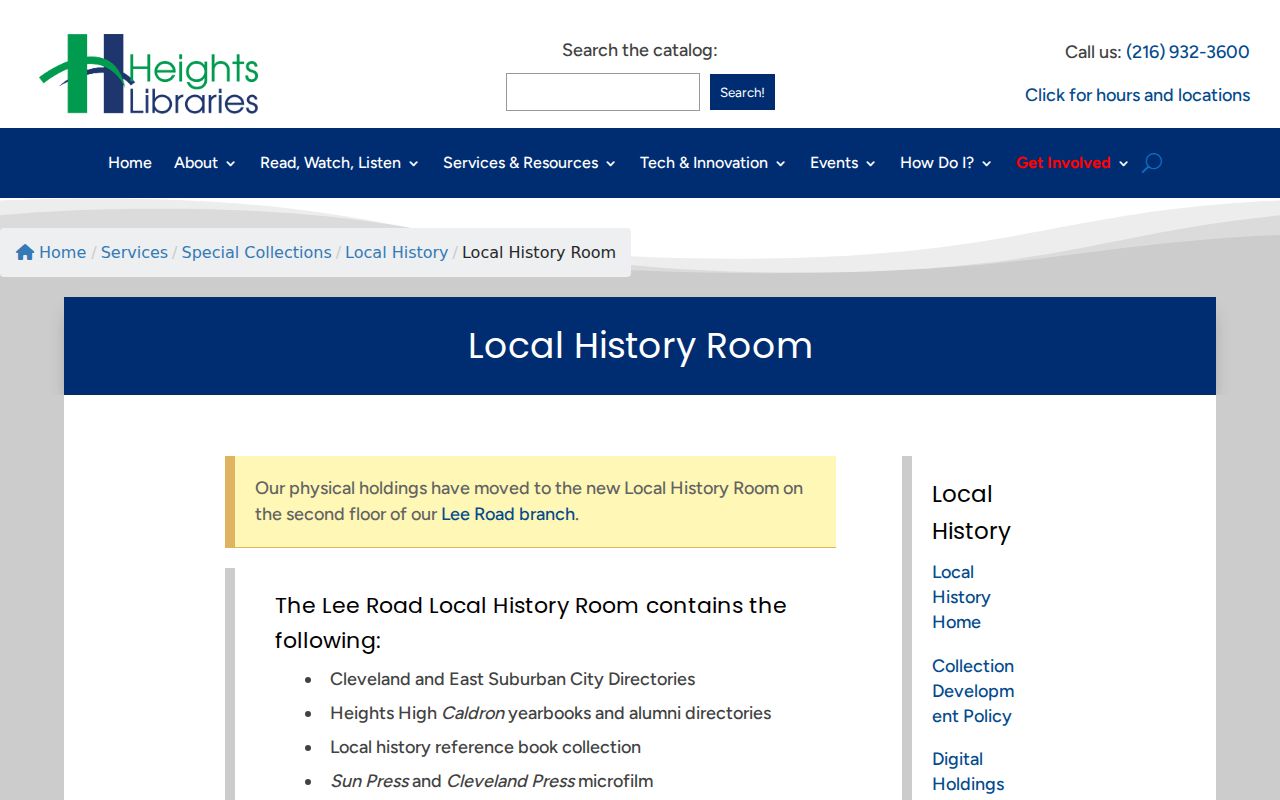
The room's local focus can turn a printed name into a better dated family-history lead, especially when a directory uses initials or an abbreviated occupation.
Cleveland Heights City Directory Entries Decoded
Read a Cleveland Heights city directory entry as a dated transcription, not a summary from memory. CPL documents name, occupation, and other information in the basic entry. Wives' names first appear in the Cleveland series in 1929. That same year, properties were listed by address at the end of a volume, which creates an early bridge between a person and a street. The Historical Society likewise describes directory entries as name, address, and occupation, rather than a simple phone-book listing.
| Printed name | Copy initials, suffixes, spelling, and punctuation exactly as printed. |
|---|---|
| Spouse name | Record it only when the selected volume prints one; the Cleveland series first did so in 1929. |
| Address | Keep the house number, street spelling, and the directory year together. |
| Occupation | Transcribe it as a historical clue, not as a present-day status. |
| Evidence details | Capture title, publisher, page or column, and the volume's abbreviation key. |
- Criss-cross directory
- An address-to-occupant directory. Begin with the street number, then confirm the name in an alphabetical volume.
- Householder index
- A name-oriented arrangement that helps connect a listed person to a printed address.
- Abbreviation key
- The volume's explanation of shortened terms and marks. Photograph or transcribe it with the entry.
When a later verification question concerns a modern person, a historical entry is only one dated clue. The records and cautions for that work are different on the Cleveland Heights resident lookup page.
Cleveland Heights Criss-Cross Directories
A conventional Cleveland Heights alphabetical volume runs from name to address and occupation. A criss-cross directory reverses that path: address to occupant or name. The Cleveland Heights Historical Society identifies Crisscross Directories at CPL History/Geography and describes Cleveland Blue Books with address-based street listings in their main body. CPL lists Cleveland-area criss-cross holdings for 1923, 1926, 1937, and 1960 onward, but the research does not establish a complete local run.
Use the exact street number and the period street spelling first. Then open the corresponding alphabetical volume to compare the name variant and occupation. A tax or deed record is necessary to distinguish a recorded owner from a listed occupant. Ask CPL for a holdings check before assuming a particular year exists. That modest check is better than building a family trail on a guessed volume.
Cleveland Heights Household Directory Trail
For family history, follow one Cleveland Heights listing across nearby years and pair it with independent dated records. Begin with the exact person spelling, address, and year. A disappearance may reflect a missing publication, a move, death, a name variation, or an unlisted household. The nearest released federal census can add the household relationships, age, and place-of-birth context that directories usually do not show. The 1950 census is public; later schedules remain closed until their release years.
- Find the earliest confirmed directory entry and preserve the title, year, page, and column.
- Check the next available volume, not merely the next calendar year, and note any documented publication gap.
- Use a criss-cross or address listing when available to test the street number and nearby listed occupants.
- Pair the directory period with the nearest released census, map, deed, or tax record.
- For a final disappearance, check newspaper, obituary, cemetery, or Probate estate research channels with the exact dated name.
The County Archives adds estate indexes from 1813 to 1993 and estate files from 1813 to 1918, while current probate matters stay with the Probate Court. Those sources can explain a transfer or family connection, but a directory entry alone does not prove ownership or list every household member.
Note: Preserve a source date with every name and address because Cleveland Heights directory entries describe a publication cycle, not an undated fact.
Cleveland Heights Directory Companions
Directory evidence gains strength when it is paired with local materials that answer a different question. The Historical Society resource guide points to City permits and plats, County Archives maps, appraisal cards, directories, and regional library holdings. County Archives building cards, generally from about 1935 to 1970, can supply footprint, size, exterior-detail clues, and sometimes a 1950s image. City Hall holds original permits for some homes after 1915, and Planning has reference plats for 1898, 1912, 1914, 1920, and 1941.
The Cleveland Heights Historical Society resource guide ties those sources together. Its image in the manifest reflects a local route to criss-cross books, permits, plats, newspapers, and library shelves. Use it to plan a request, then rely on the office or repository that actually holds the record.
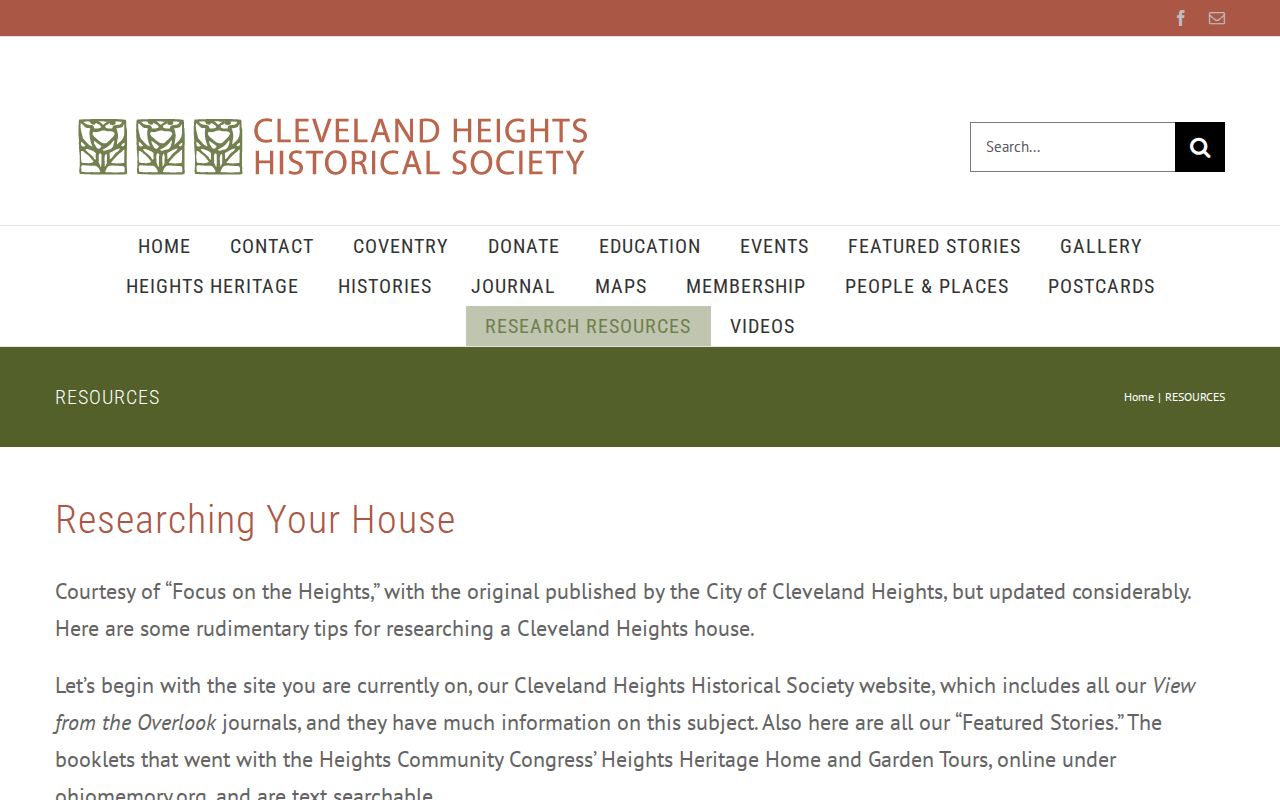
Maps and building cards add place and structure details around a Cleveland Heights directory finding. They do not replace the printed entry or establish a person's present connection to an address.
Cleveland Heights Directory Memory Sources
Heights Libraries maintains digital local-history holdings that point to clipped newspapers, photographs, organization records, Ohio Memory, and Cleveland Memory. The Historical Center and historic-photo material can help date a school, club, street, or institution that appears beside a name. Sun Press microfilm reaches back to the 1920s, and Heights newspapers from 1922 through 1926 have been scanned into the library's Ohio Memory contribution. Check scan text against the original image because OCR can misread initials and street names.
Use the Heights Libraries digital holdings as a companion to the directory search. The captured collection page identifies where those local memory sources begin. A clipping or photograph can supply context, while the dated directory volume remains the direct source for its printed entry.
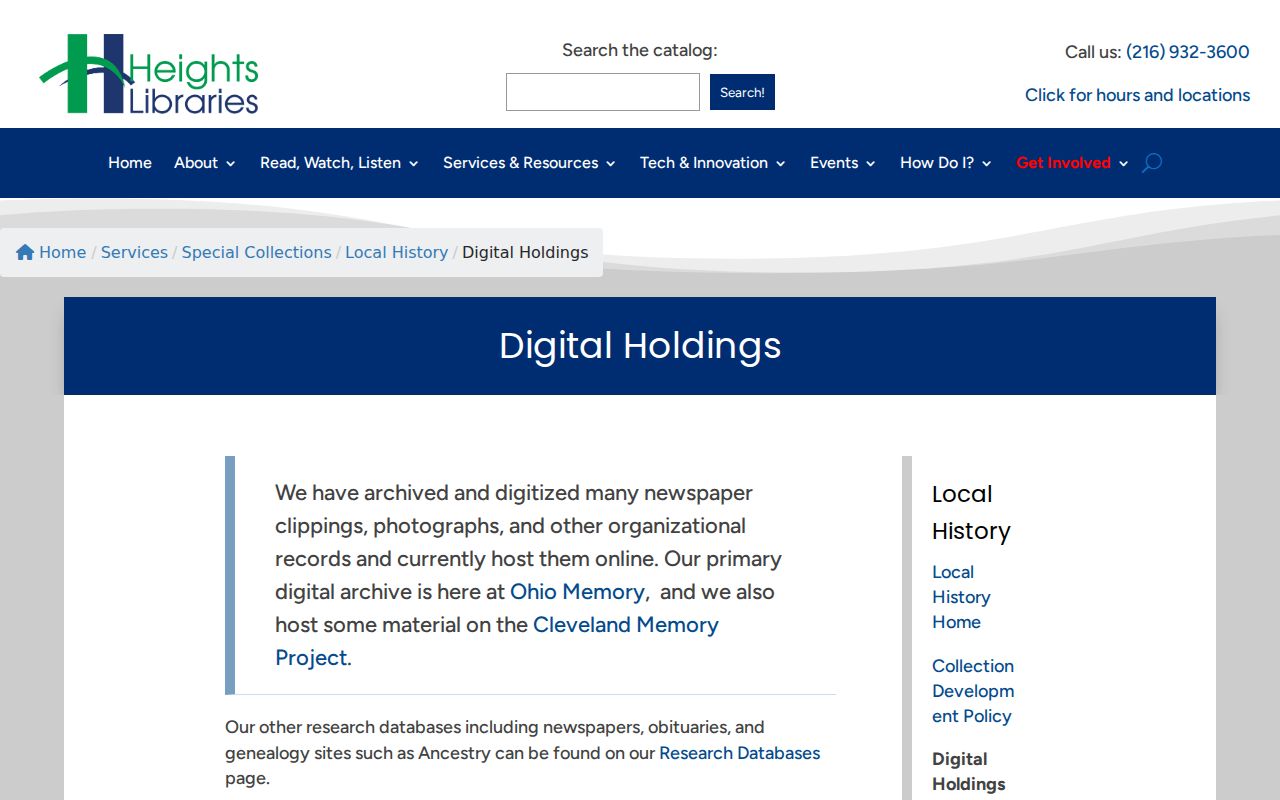
These digital materials are especially useful when a Cleveland Heights city directory shows only an initial, a brief occupation, or a familiar street name without further family detail.
Cleveland Heights Directory Digitization Watch
In 2026, the Ohio History Connection listed a Cleveland Heights Scanning and Conversion Initiative among its History Fund projects. The stated project is intended to digitize public meeting minutes, building permits, and early planning records through Ohio Memory. It is a planned access expansion, not a promise that a specific directory or permit is already online. Confirm availability with the holding institution before citing a record as digitized.
The initiative fits the wider Cleveland Heights pattern: local history is spread across libraries, City offices, the County Archives, and state or regional collections. A careful directory search keeps the source title and date visible, then uses each custodian for the type of evidence it actually maintains.